How to store old photographs so they stop fading
Most family photographs are not damaged by accidents. They are damaged slowly, by the room they live in and the materials they sit against. Here is what actually matters, which sleeve plastics are safe, what "acid-free" and "archival" really mean, and the three places in a house you must never use.
The photographs people lose are rarely lost dramatically. There is no flood and no fire. They simply sit in a garage for thirty years and quietly turn orange, or come out of a sticky album with the image left behind on the page.
Storage is unglamorous and it is the highest-leverage thing you will ever do for a family collection. It is also mostly free.
The four things that do the damage
Heat accelerates every chemical reaction inside a photograph, including the dye fading that turns colour prints orange. A rough rule from conservation: each ten degrees Celsius of extra warmth roughly halves the material’s life.
Humidity invites mould, encourages prints to stick to each other and to glass, and makes emulsions soft. Damp is worse than warm.
Light bleaches dyes, and ultraviolet does it fastest. A photograph framed on a sunny wall for twenty years is being slowly erased in plain sight.
Bad materials do damage all on their own. PVC sleeves, sticky album pages, rubber bands, paper clips, sticky tape and ordinary cardboard all attack photographs chemically over years.
Notice that three of those four are decided entirely by which room you choose.
The three worst places in your house
They are, unfortunately, the three places almost everyone uses.
The attic. Enormous temperature swings, brutally hot in summer. The single most destructive room in a typical home for photographs.
The garage. Damp, unheated, wildly variable, and full of vehicle fumes.
The basement. Humidity and flood risk together, which is the worst possible pairing.
To that list add anywhere near a bathroom or kitchen, any external wall that gets cold enough to condense, and the top of a radiator or a boiler cupboard.
Where to put them instead
An interior cupboard or wardrobe on a living floor, against an internal wall. It is not exciting advice. It is also the whole answer, because that space is naturally cool, dark, dry and, crucially, stable.
Stability deserves emphasis. Photographs cope better with a constant slightly warm room than with a cooler room that swings ten degrees every day. Every cycle expands and contracts the layers of the print, and eventually they separate.
Aim loosely for cool room temperature and moderate humidity, roughly 30 to 50 percent. You do not need a hygrometer for a family collection, but if a room ever smells musty, that is your answer and you should move them.
Materials, and what the labels actually mean
Once the room is right, the only remaining variable is what the photographs are touching. That is where the shopping gets confusing, because the vocabulary on a box of sleeves is used loosely and some of it is not regulated at all. Three questions get you to a good product: what is it made of, what has it been tested against, and is it the right choice for the kind of photograph going inside it.
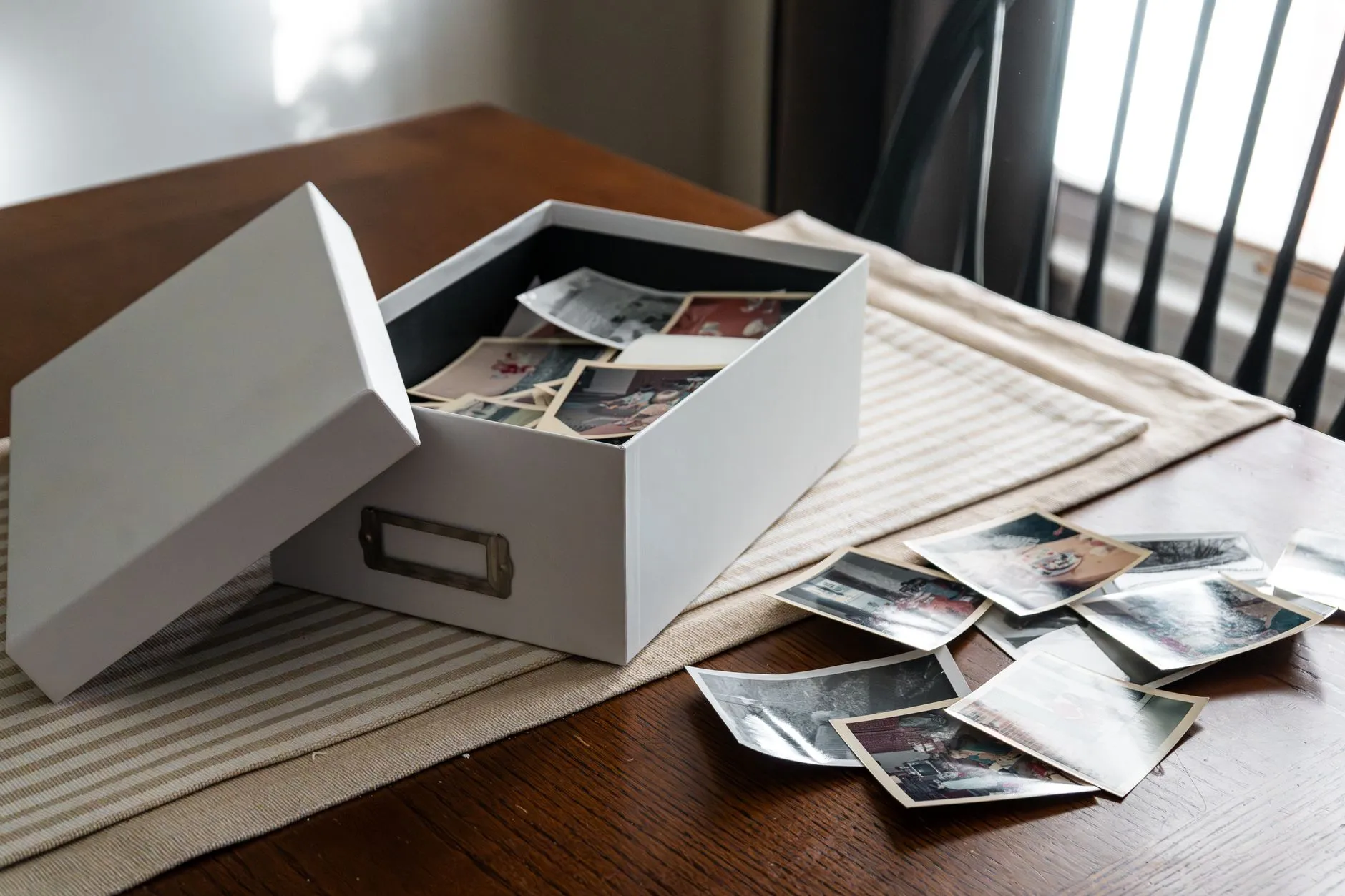
Boxes beat albums for anything you are not looking at often. A simple archival box with prints stored upright and properly supported is better than most albums, cheaper, and easier to get things out of.
Acid-free, lignin-free, and the word that proves nothing
Acid-free is real, and it is a snapshot in time. It means the material measured a near-neutral or slightly alkaline pH when it was tested. That is a genuine, checkable property, not pure marketing. What it does not tell you is what the material will be in ten years. Paper can be acid-free and still contain lignin, the substance in wood pulp that gives it stiffness. Lignin oxidises slowly and throws off acids as it goes, so a sheet that tested acid-free on the shelf can be measurably acidic a decade later.
Lignin-free is the claim that protects the future tense. It means the pulp has been purified, usually through a proper chemical process rather than simple bleaching, so the lignin that would have degraded into acid is gone. Cotton rag paper and properly purified wood pulp can both be lignin-free. Ask for both words together. Acid-free is a starting condition. Lignin-free is what stops that condition quietly reversing itself inside a closed box.
Archival is not a regulated word. It has no legal definition and no test behind it. Any manufacturer can print it on any product, and plenty do, on materials ranging from genuinely excellent to actively harmful. The same is true of museum-quality and of photo-safe used with no further detail. None of that makes every product carrying the word bad. It makes the word decoration rather than evidence, so look past it for something you can check. Two things are worth looking for specifically.
A named standard. ISO 18902 is the international standard for photographic storage enclosures, and products that genuinely meet it usually say so rather than gesturing at archival quality. A supplier confident enough to name a standard is normally confident because the material earned it.
The Photographic Activity Test. The PAT, standardised as ISO 18916, is a real laboratory test that checks whether a storage material reacts with a photographic image over time. A product stating it has passed PAT has been tested against an actual photograph, not simply had its pH measured in isolation. Plenty of safe products never mention it, because the test is aimed at institutional archives more than at shoppers, but where you do see it, it means something.
If a pack offers the word archival and nothing else, treat it as a product that has told you nothing.
Buffered or unbuffered, and why that is not a detail
Alkaline buffering means the manufacturer has added a mild alkaline reserve, usually calcium carbonate, to a paper or board so it can absorb acids arriving from the surrounding environment and stay near-neutral for longer. It sounds like a pure upgrade. For most materials it is. For a few it is the wrong choice.
Buffered suits plain paper documents, black and white silver-gelatin prints, and most negatives on a stable base. The reserve is soaking up acids arriving from outside, whether from the air, from adjacent materials, or from the paper itself over decades.
Unbuffered is the safer choice for colour photographs, chromogenic prints and colour negatives, cyanotypes, and anything with a dye-based image. Some dye chemistries are sensitive to an alkaline environment and can shift or fade faster against a buffered material. Conservators have moved toward unbuffered as the default for colour precisely because that failure mode, a print whose colours have slowly moved and cannot be moved back, is worse than the acid migration buffering was guarding against.
For a mixed family box you cannot realistically sort by process, unbuffered is the conservative pick. It protects the colour material correctly and does no real harm to the black and white sitting beside it.
The three plastics that are safe, and the one that is not
For sleeves, the single most useful thing a label can tell you is the name of the plastic.
Polyester, often sold under the trade names Mylar or Melinex, is the gold standard. It is clear, rigid, chemically stable, and off-gasses nothing that migrates onto an image. Conservation-grade sleeves and negative pages are almost always polyester.
Polypropylene is the common middle ground. A little softer than polyester, still stable, and what most reasonably priced photo sleeves and album pages are made from. Fine for family use.
Polyethylene is the softest and cheapest of the three, used for resealable bags and lower-cost sleeve products. Also stable and safe, just less rigid and less clear than the other two.
All three are inert enough that a photograph can sit against them for decades without harm. If a product names one of them, buy it with confidence.
PVC, sometimes labelled vinyl, is the one to avoid. It is kept flexible with plasticisers, chemical additives that are never permanently bonded into the plastic. Over years those plasticisers migrate out of the sleeve and onto whatever they are touching. On a photograph they stick to the image surface, attract dust and grime, and can eventually soften or damage the image layer itself. The process is slow, which is exactly why it goes unnoticed until the damage is done. PVC used to be everywhere in cheap albums and sleeves, and it still turns up in generic stationery-aisle products that name no plastic at all. It is the same migration mechanism that fuses prints into old sticky albums.
How to spot PVC with no label to read
You do not need a laboratory for this. PVC sleeves feel noticeably softer and tackier than polyester or polypropylene, and two sheets rubbed together tend to cling slightly to each other. New PVC often carries a faint plasticky or slightly sweet chemical smell, more noticeable if you warm a sheet briefly between your hands. Polyester and polypropylene, by contrast, feel stiff and crisp and are close to odourless.
If a sleeve smells like a plastic shower curtain, do not put a photograph in it.
Paper enclosures, and when they beat plastic
Safe plastic is a genuine convenience in a home collection. You can see a photograph without handling it, and a stack of sleeved prints is easy to flick through. Paper enclosures, specifically acid-free and lignin-free paper, have one advantage plastic cannot match: they breathe.
In a genuinely humid climate, or in any room prone to damp, plastic traps moisture directly against the surface of a print. Over time that trapped humidity encourages mould and can glue the print to the inside of its sleeve, sometimes firmly enough to take the image layer with it on removal. Paper lets moisture move through rather than pool against the emulsion, which makes it the lower-risk choice in damp conditions and for any photograph that has already shown a sign of damp. If a print carries marks from an earlier water incident, our guide on stains on old photos covers what is and is not recoverable.
In a dry, stable house this is a minor consideration. In a damp one it is the whole decision.
A checklist you can run in a shop
Standing in an aisle, or scrolling a listing, this is what to check, in order:
- Does it name the plastic? Polyester, polypropylene or polyethylene printed on the pack is a factual, checkable claim. Archival quality is not.
- Does it say vinyl? Vinyl is PVC under a friendlier name. Put it back.
- On paper products, does it say acid-free and lignin-free? Both words together, not one of the two.
- Is the buffering stated, and does it match what you are storing? Unbuffered if you are unsure, or if the box is mixed.
- Does it name a standard? ISO 18902, or a mention of PAT testing, for anything irreplaceable. A genuine bonus rather than a requirement.
- Does it smell of nothing? A chemical odour on a plastic sleeve is information, and it is telling you to choose a different product.
None of this has to be perfect to be worth doing. Getting a collection out of a sticky album and into any of the three safe plastics is already a large improvement, before you get particular about which one. Where a print has already been damaged by a bad sleeve or a tacky page, better storage stops further harm but will not undo what has happened, and our page on deteriorated and mottled photographs covers what can genuinely be recovered from that point.
The magnetic album problem
If your photographs are in a self-adhesive album from the 1970s or 1980s, the sort with tacky pages under a clear film, you have a genuine problem. Those pages yellow badly, and the adhesive bonds permanently to the backs of prints. Pulling a photograph off frequently takes the image layer with it.
Digitise before attempting removal. Scan the whole page in the album if you must, at 600 DPI, so that if a print tears on the way out you still have the image. Then remove slowly, and stop if the print resists. Dental floss slid gently underneath sometimes helps. It is unsatisfying advice, but a scan in hand beats a ruined original.
What to do this weekend
You do not need to do everything. In descending order of value:
- Move the boxes out of the attic, garage or basement into an internal cupboard. Costs nothing, and is by far the biggest single improvement available to you.
- Take out the rubber bands, paper clips and sticky tape. All three cause damage.
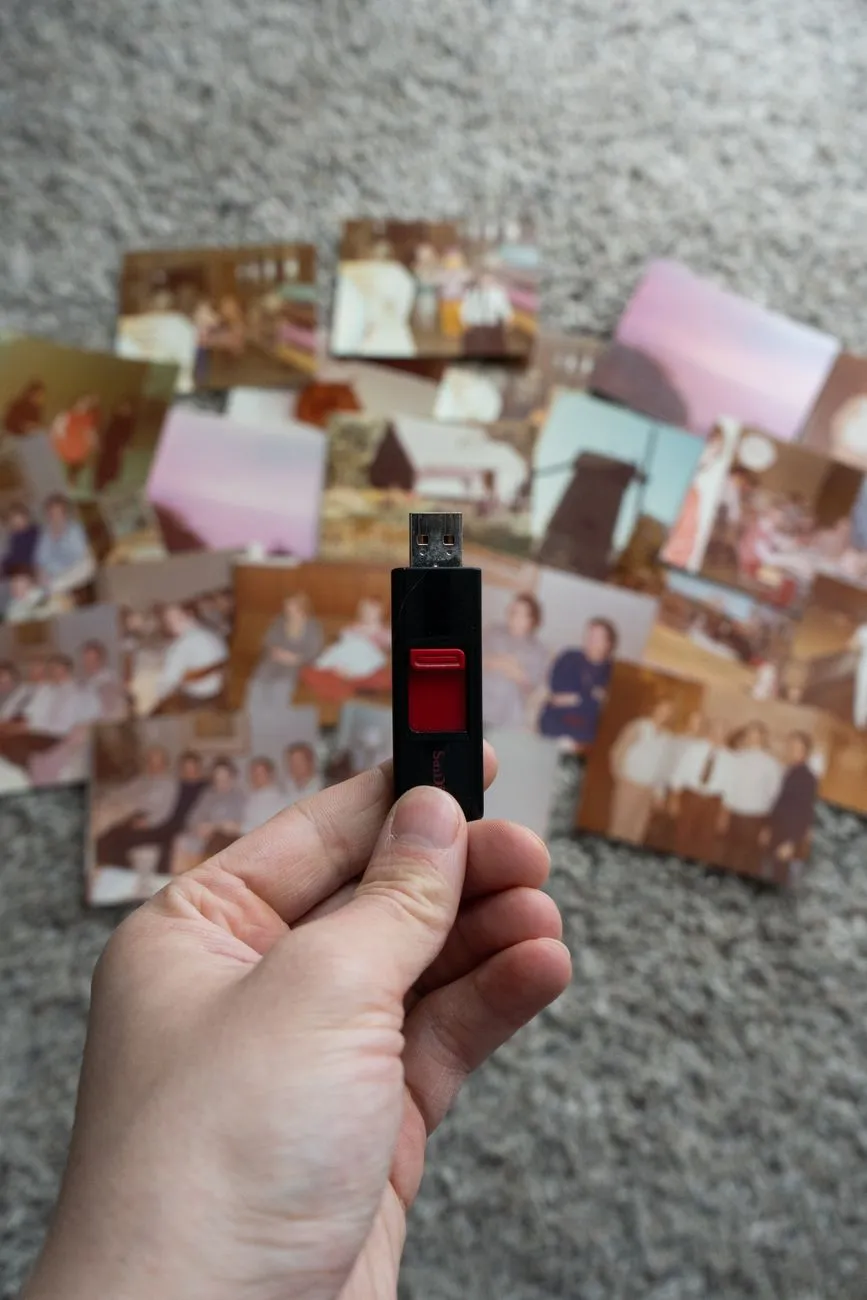
- Digitise the twenty photographs that matter most. Storage slows decay, it does not stop it. A good scan is the only genuinely permanent copy.
- Replace any PVC sleeves as budget allows.
- Take framed photographs off sunny walls, or reprint a copy for display and store the original properly.
The best-preserved photograph in the world is still one house fire from gone. Digitise the ones you love, keep a copy somewhere else, and then store the originals well.
If your prints have already faded, storage will not undo it, but our guides on why old photos turn orange and what DPI to scan at cover what can still be recovered from them.
A safe box in a good cupboard buys a photograph decades. A good scan, kept somewhere other than the house the prints live in, buys it longer than that. Our guide on backing up scanned family photos covers where those copies should actually live, and if you want a duplicate on display while the original stays safely boxed away, the pixels to print size tool will tell you how large you can print a given scan without stretching it.
Common questions
- What is the best place in a house to store photographs?
- An interior cupboard or wardrobe on a living floor, ideally against an internal wall. You want stable, cool, dry and dark. Avoid attics, basements, garages and anywhere against an external wall or near a bathroom. Stability matters as much as the absolute temperature, because repeated swings do more harm than a consistently slightly warm room.
- Does acid-free actually matter, or is it marketing?
- It genuinely matters, but the phrase is used loosely. Look for storage described as acid-free AND lignin-free, and for plastics specify polyester, polypropylene or polyethylene. What you are avoiding is PVC, which releases plasticisers that stick to and eventually destroy image surfaces. If a plastic sleeve smells strongly, do not use it.
- Are magnetic photo albums bad for photographs?
- Yes, and they are among the worst things in a typical family home. The self-adhesive sticky pages yellow, and their adhesive bonds permanently to the back of prints, so removal frequently takes the image layer with it. If your photographs are in one, digitise them before attempting removal.
- Should photographs be stored upright or flat?
- Upright in a supported box for most prints, so they are not crushed under their own weight, and flat for anything large, brittle or already cracked. Either way, avoid partially filled boxes where prints can slump and bend.
- What plastic is safe for storing old photographs?
- Polyester (also sold as Mylar or Melinex), polypropylene and polyethylene are all stable and safe for long-term contact with photographs. Polyester is the clearest and most rigid, polypropylene is a common middle ground, and polyethylene is the softest and cheapest of the three. All are fine. What to avoid is PVC, sometimes labelled vinyl.
- How do I know if a sleeve is PVC without a label?
- Feel and smell. PVC sleeves are noticeably softer and tackier than polyester or polypropylene, and they tend to cling to themselves. New PVC often has a distinct plasticky or slightly sweet chemical smell, especially if you warm it briefly between your hands. If a sleeve is stiff, crackly and nearly odourless, that is a good sign it is polyester.
- Is "archival" on the packaging enough to trust it?
- No. Archival is not a regulated term and any manufacturer can print it on anything, and the same goes for museum-quality and photo-safe. Look instead for the actual plastic named on the pack, polyester, polypropylene or polyethylene, and for products that name a standard such as ISO 18902 for enclosures or state they have passed the Photographic Activity Test (ISO 18916). Those claims are independently checkable. The word archival on its own is not.
- What does lignin-free mean, and why does it matter more than acid-free alone?
- Lignin is the substance that gives wood its rigidity, and it is still present in cheap paper pulp. It breaks down into acids over years even if the paper tested acid-free on the shelf. Lignin-free means the pulp has been purified enough to remove it, so the paper stays acid-free instead of becoming acidic later. For anything meant to last decades, lignin-free is the more meaningful claim.
- Should I buy buffered or unbuffered photo storage?
- Unbuffered for colour prints, chromogenic negatives and anything with a dye-based image, because the alkaline buffer can react with those dyes over time. Buffered is fine and often preferable for black and white silver-gelatin prints and for plain paper documents, since it neutralises acids migrating in from the surrounding environment. If you cannot tell what you have, unbuffered is the safer default.
- Should I use paper or plastic to store old photographs?
- Plastic is fine in a stable, dry home. In a genuinely humid climate, or for a room prone to damp, acid-free and lignin-free paper enclosures are the safer choice, because plastic can trap moisture against the print surface where paper lets it breathe. If you have already had mould or stains on a photograph, paper is the lower-risk option going forward.