How to identify a real photo postcard, and how to date one
Two cards from the same shoebox can look identical and be completely different objects. One is a printed souvenir, the other a genuine photograph developed onto postcard stock. Here is the three second loupe test that tells them apart, what the stamp box and divided back can and cannot prove about the date, and why these cards reward a careful scan.
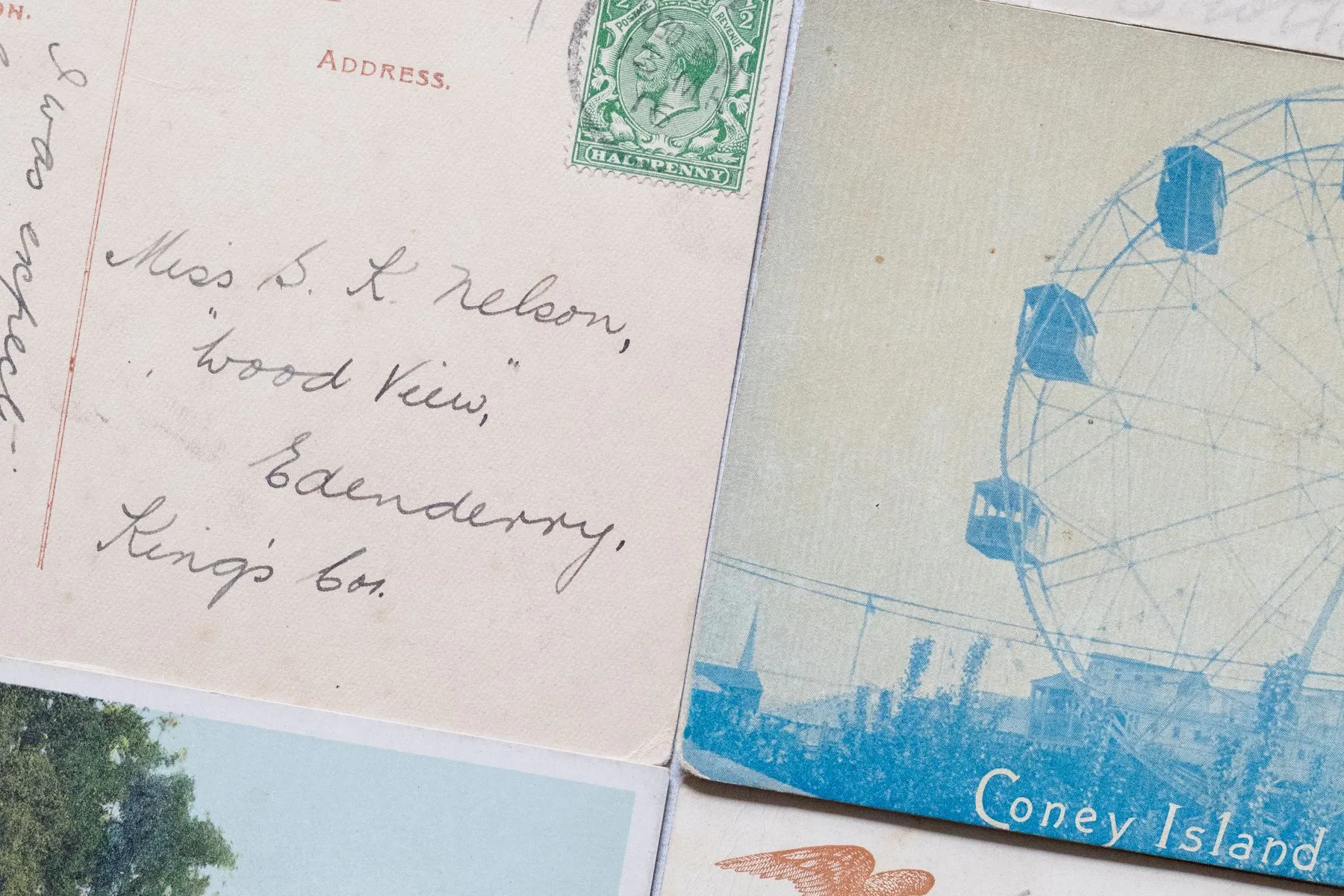
Open a box of old postcards and most of what you are holding is printed ephemera: a scenic view, a hotel, a humorous drawing, run off a printing press by the thousand. Sitting among them, every so often, is something different. A real photo postcard is an actual photograph, developed directly onto paper that happened to be manufactured with a postcard back, and it is usually a portrait, a family snapshot, or a view of a specific street or house that nobody printed anywhere else. Treat it like the printed cards around it and you risk losing the one object in the box that cannot be replaced.
The three second test
Hold the card up to good light and look closely at the image, ideally with a loupe or even a strong reading glass. You are looking for one thing only.
A printed postcard is built from dots. Commercial printing of the period used a halftone screen, tiny dots of varying size arranged in a pattern, which the eye blends into a smooth picture from a normal reading distance. Get close enough and the dots resolve into a visible grid or rosette pattern, especially across a flat area like sky or water.
A real photo postcard has no dots at all. It is a continuous tone photographic print, the same emulsion you would find on an ordinary snapshot, just coated onto postcard stock instead of plain photographic paper. Under the loupe the tone is smooth and grainy rather than dotted, exactly like any other silver gelatin photograph.
That is the whole test. A printed scenic view of Niagara Falls bought at a gift shop will show a dot pattern every time. A studio portrait of your great grandmother, printed onto postcard paper so it could be mailed to relatives, will not.
Why the difference matters
A printed postcard is a mass produced object. Thousands of identical copies exist, or once did, and losing one particular copy rarely loses the image itself. A real photo postcard is usually the only copy of that photograph that was ever made. No negative survives in most cases, no second print exists in a shop or an archive, and the card in your hand is the whole photographic record of whoever or whatever it shows.
That changes how it is worth handling. A real photo postcard deserves the same care as any irreplaceable family photograph: careful scanning, proper storage, and the same honest expectations about what restoration can and cannot do for a damaged original. A printed card can be treated as the souvenir it is.
The divided back, and what it actually proves
Once you know you are holding a real photo postcard, the back carries genuine dating evidence, with an important caveat.
In the United States, postal regulations only allowed a message on the address side of a postcard from 1907 onward. Before that, the entire back was reserved for the address and the stamp, and any message had to be squeezed onto the front around the image. A card with an undivided back, where there is no line separating an address half from a message half, is therefore usually from 1907 or earlier. A divided back, with a printed line splitting the reverse into an address side and a message side, means the card was printed as postcard stock in 1907 or later. Similar conventions, on slightly different dates, apply outside the United States.
Layered on top of the divided back is the paper stamp box, the small printed rectangle where a postage stamp goes. Manufacturers such as Kodak sold postcard backed photographic paper under names like Velox, Azo and Cyko, and changed the stamp box artwork periodically across the decades. Collectors have catalogued which box designs belong to which rough span of years, in the same way they have for the mount styles on a cabinet card. Matched against a published reference, a stamp box can sometimes narrow a card to a specific handful of years.
The honest caveat, the same one that applies to any paper based evidence, is that a stamp box and a divided back date the paper stock and the printing convention, not the moment the shutter clicked. A photographer could buy a box of postcard paper and use it across several years, and a print could be made from an older negative onto newer paper. Our guide to what the stamps and numbers on the back of an old photograph actually mean covers this distinction in more depth, because it applies to ordinary prints as much as it does to postcards. Treat the back as a floor under the date, not a fixed year, and combine it with whatever the image itself shows, clothing, a car, a visible calendar or shopfront, before settling on a range.
Why these cards are worth scanning properly
A real photo postcard is a contact print. It was exposed at the same size as the negative used to make it, with no enlargement in between, which means the image can hold considerably more fine detail per inch than its small size suggests. Scan one at a casual setting and you will lose information the print actually contains.
Scan at 1200 DPI for a standard postcard sized print, higher than you would use for an everyday 4x6 snapshot, because the card is small and the detail is real. Our scan DPI calculator will confirm the right setting for the exact card in front of you, and our fuller guide to what DPI to scan old photos at covers the colour mode and file format choices that matter just as much as the resolution number.
Scan both sides. The back is where the dating evidence lives, and a faint pencil note or a partly worn stamp box can be far easier to read in a scan than by eye. Keep the front and back scans named so the pairing is obvious.
Real photo postcards that were actually mailed and handled for decades often carry genuine surface grime, fingerprints, and the general haze of having passed through dozens of hands and a postal system with no particular care for the image. That kind of damage sits on top of an intact photograph and responds well to cleaning, as our page on surface dirt and grime sets out, so do not mistake a dirty card for a ruined one. Scan it as it is first, exactly as you would any other old photograph, and decide what to do about the grime afterwards.
A sensible way to sort a mixed box
Work through a box of postcards with the loupe test first, before worrying about dates or condition. Set the printed scenic cards and souvenirs aside, they are pleasant ephemera and rarely urgent. Pull every real photo postcard into its own pile, because each one is a photograph that exists nowhere else, and scan those first. Only once the irreplaceable cards are safely digitised is it worth going back to date them properly from the back, since a scan in hand beats a guessed year attached to an original that has not been copied yet.
Common questions
- What is a real photo postcard?
- A genuine photograph, usually a portrait or a local snapshot, printed directly onto photographic paper that was manufactured with a postcard back already on it. It is a one off photographic print, not a mass produced image. The far more common postcard in any family collection is a printed souvenir, made by a commercial printing process in large runs, and the two are easy to mix up until you know what to look for.
- How can I tell if my postcard is a real photograph and not a printed one?
- Look closely at the image, ideally with a loupe or a strong magnifying glass, under good light. A printed postcard is built from a pattern of tiny dots, a halftone screen, and you will see it as soon as you get close enough. A real photo postcard has a continuous photographic tone with no dot pattern at all, the same as any other silver gelatin print. That single check settles it in a few seconds.
- Does a divided back mean my postcard is from a specific year?
- It narrows the range rather than fixing a year. In the United States, postcards could only carry a message on the front until 1907, so an undivided back, where the whole reverse is address only, usually means 1907 or earlier. A divided back, with space for a message beside the address, means 1907 or later. Combine that with the paper stamp box design for a tighter estimate, and treat both as evidence about the paper and the printing convention rather than proof of the exact year the photograph was taken.
- What resolution should I scan a real photo postcard at?
- Higher than its small size suggests. A real photo postcard is a contact print, made at the same size as the camera's negative with no enlargement, which means it can hold a surprising amount of fine detail for its footprint. Scan at 1200 DPI if the card is standard postcard size, and scan both sides, since the stamp box and any handwriting on the back are dating evidence worth keeping. Our scan DPI calculator will confirm the setting for the exact card in front of you.