Tintype, ambrotype or daguerreotype: how to tell what you have
A three question test you can run at the kitchen table to tell a tintype, an ambrotype and a daguerreotype apart, what each format means for the photograph's real age, and why the format itself decides how you should handle and scan it.
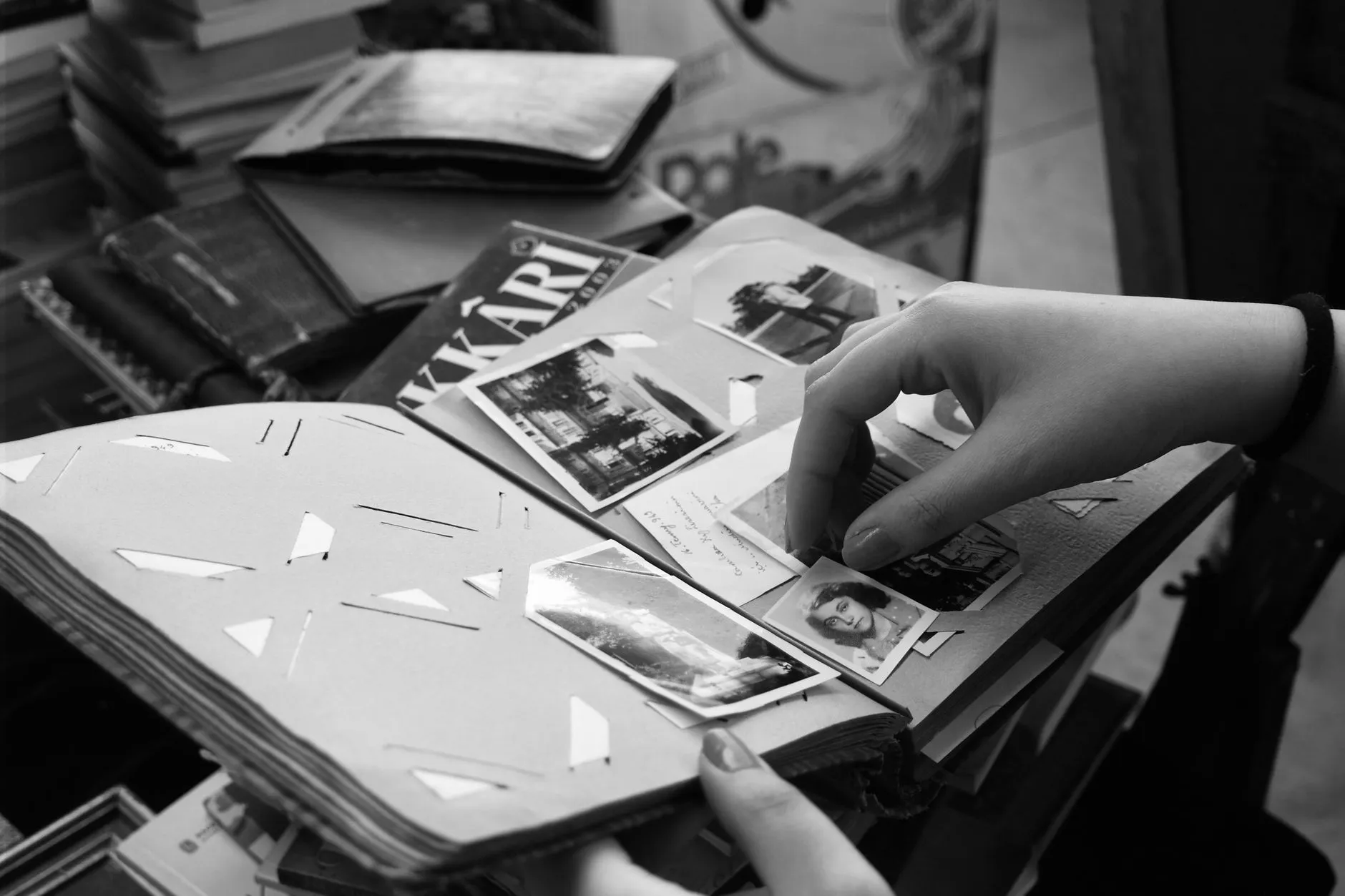
If you have found a small, heavy, oddly reflective old photograph in a case or a drawer, it is probably not printed on paper at all. Between roughly 1839 and the early 1900s, the three most common studio formats for a single original portrait were the daguerreotype, the ambrotype and the tintype, and they are easy to confuse because they can look almost identical at a glance: a dark, one-of-a-kind image, often housed in a small hinged case with a padded lining. They are built completely differently underneath, and telling them apart takes about thirty seconds with three simple checks, no expert required.
The three question test
Run these in order, at a kitchen table, without opening any case or touching the image surface.
Does a magnet stick to it? A tintype is made on a thin sheet of lacquered iron, so a small magnet held near the back or edge will grip it, sometimes faintly through a case lining. A daguerreotype and an ambrotype will show no response at all, because neither is made on iron.
Does the image flip between a positive and a ghostly negative as you tilt it? This is the tell for a daguerreotype specifically. The image sits directly on a silvered, mirror-polished copper plate, so as you rock it gently under a light, the picture visibly shifts between reading as a normal portrait and reading as a pale, reversed, almost spectral image. Nothing else does this. An ambrotype or a tintype looks like a steady positive picture no matter what angle you view it from.
Is the image on glass or on metal? If the magnet test was negative and there was no flip effect, this last check confirms it. A pane of glass with a dark backing visible behind it is an ambrotype. There is no fourth combination to worry about: those three checks between them cover all three formats.
Put together, a positive magnet result means tintype, a positive flip effect means daguerreotype, and glass with neither effect means ambrotype.
What each format actually is
The daguerreotype (roughly 1839 to the early 1860s) is a direct positive image formed on a silver-surfaced copper plate, with no negative involved at any stage. Every daguerreotype is therefore completely unique. It was expensive, slow to sit for, and largely confined to professional studios, which is part of why surviving examples are often formally posed and carefully cased.
The ambrotype (roughly the mid-1850s to the mid-1860s) is a glass plate negative that reads as a positive because a dark backing, usually black varnish, paper or fabric, sits directly behind it. It was cheaper and faster to produce than a daguerreotype and briefly overlapped with it before tintypes took over the low end of the market entirely.
The tintype (from 1856 well into the early 1900s, and occasionally later at fairs and seaside studios) is the same idea as an ambrotype, an underexposed image read as a positive against a dark background, except the image sits on a thin, dark-lacquered sheet of iron rather than glass. It was the cheapest and toughest of the three, which is why tintypes turn up loose in boxes and albums far more often than in a formal case.
What the format tells you about age, and what damage is normal
The format alone narrows the date more usefully than most other clues on an unlabelled photograph. A daguerreotype almost certainly predates the mid-1860s. An ambrotype sits in a narrow decade either side of 1860. A tintype could be from the Civil War era or from a boardwalk studio decades later, so it dates a photograph the least precisely of the three, even though it is the easiest format to identify.
Each format also has its own kind of damage that is normal for its age rather than a sign of mishandling. A daguerreotype commonly shows tarnish creeping in from the edges of the plate in faint rainbow or cloudy patterns, which is silver reacting with the air over a century, not neglect. An ambrotype’s dark backing can flake, craze or lift away from the glass in patches, dimming or blotching the image behind it. A tintype’s lacquer coating can crack into a fine web or rust through at a scratch, since the base underneath is genuinely iron. Our page on deteriorated and mottled photos covers what this kind of age-related surface change looks like across formats generally, and what a careful scan can still recover from underneath it.
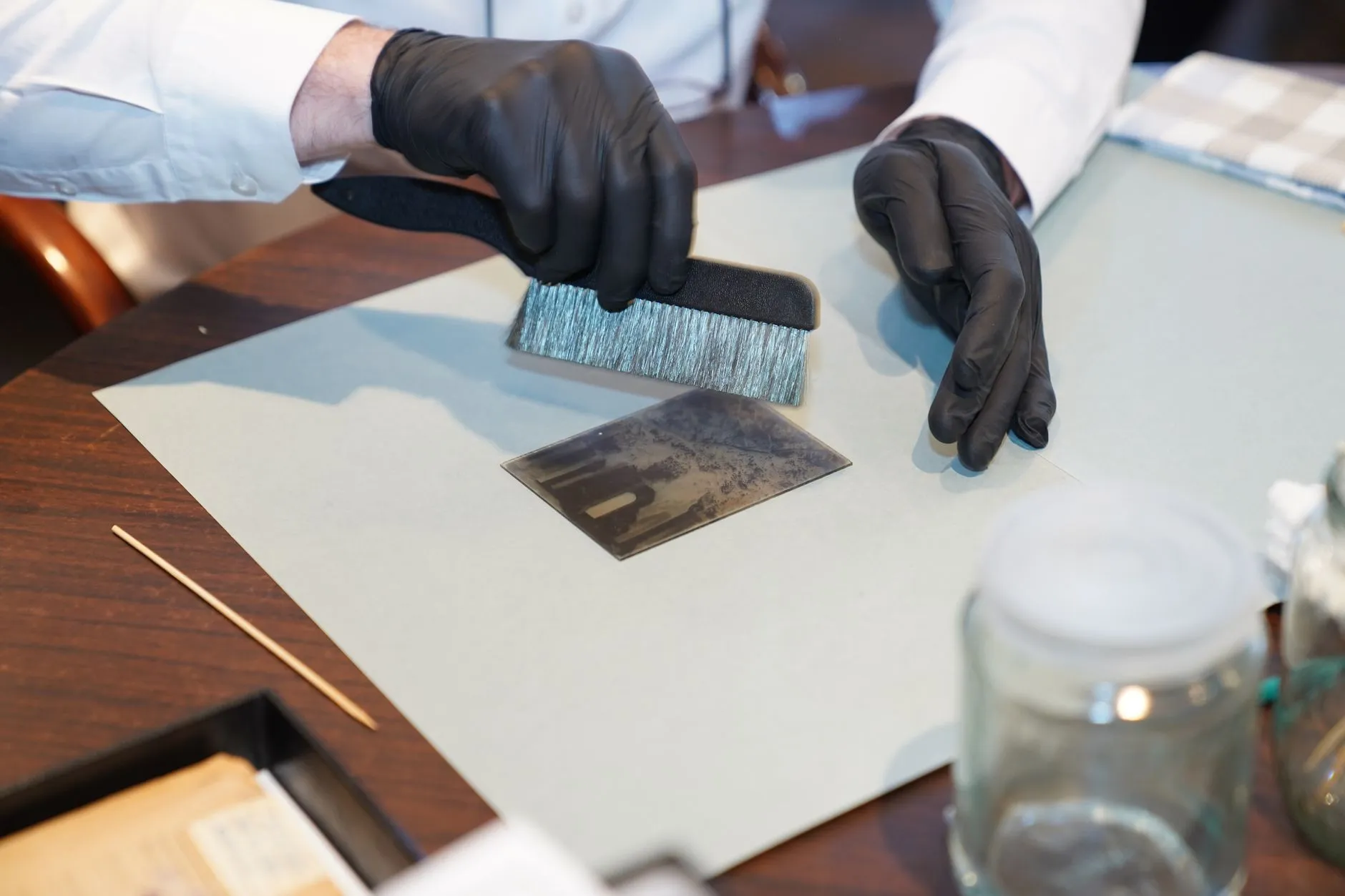
None of these three formats should be cleaned, polished or wiped by hand. The image itself is part of the surface, not a separate layer sitting on top of it, so a cloth or a cleaning solution can remove the picture along with what you were trying to remove. If the surface is simply dusty rather than tarnished or flaking, our guide to surface dirt and grime explains why a scan, not a wipe, is almost always the safer first move.
How each one scans, and why a mirror defeats a flatbed
A tintype is the most forgiving of the three to scan directly. It is a solid, reasonably tough metal sheet, so a flatbed scanner handles it much like an ordinary photographic print, aside from a little glare off the lacquer that repositioning usually clears.
An ambrotype is more delicate because of the glass and the fragile backing behind it. It can go on a flatbed face down if the backing is intact and stable, but if the black backing is already flaking, capturing it soon matters more than capturing it perfectly, since a flatbed’s light pressure can dislodge what is already lifting.
A daguerreotype is the one format a flatbed scanner genuinely struggles with. Its mirror-polished surface reflects the scanner’s own light source and lid straight back into the sensor, which usually returns glare, a washed-out plate, or a faint image of the scanner’s own interior instead of the portrait. Photographing it with a camera works far better: mount it on a tripod, tilt it slowly against a plain dark background and out of direct light, and take several frames at slightly different angles until one shows a clean, steady positive. Whichever format you are scanning, our scan resolution calculator will tell you a sensible setting for the plate’s actual size, which is usually small enough that a modest DPI setting already captures it at an archival standard.
Living with what you have
Once you know which of the three you are holding, treat the case as part of the object, not packaging to discard. Original cases, sleeves and mats were often made specifically for that plate’s dimensions and are part of its history. Store it the way you would any fragile, irreplaceable item rather than alongside ordinary paper prints. Our guide to storing old photographs covers the enclosures and conditions that suit cased images as well as paper ones.
Knowing the format tells you roughly when a photograph was made and how to handle it safely. It says nothing about who is looking back at you, which is a separate piece of detective work built on family knowledge, clothing and studio evidence rather than the plate itself.
Common questions
- How do I know if my old photo is a tintype or a daguerreotype?
- Run three quick checks. Hold a magnet near it. If it grips, you have a tintype, because the image sits on a sheet of iron. If nothing happens, tip the photograph slowly under a light. A daguerreotype flips between looking like a normal picture and looking like a ghostly negative as the angle changes, because the image sits on a mirror-polished plate. If it stays a steady positive from every angle and is mounted on glass rather than metal, you have an ambrotype.
- Why does my old photo look like a negative when I tilt it?
- That flip is the single clearest sign of a daguerreotype. The image is suspended on a silvered, mirror-polished copper plate rather than printed on paper, so what you see depends on the angle of the light bouncing off it as much as on the picture itself. Ambrotypes and tintypes do not do this: they read as a steady positive image from any angle you view them from.
- Does a magnet stick to a daguerreotype?
- No. A daguerreotype's plate is copper with a silver surface, and neither metal is magnetic. Only a tintype, made on a thin sheet of iron, will grip a magnet. This is the fastest way to rule a tintype in or out before you look at anything else.
- Can I scan a daguerreotype on a flatbed scanner?
- Not well. The mirror-polished surface reflects the scanner's own light and lid straight back at the sensor, which usually produces glare, a washed-out plate, or a faint reflection of the scanner's interior instead of the portrait. A daguerreotype photographs far better with a camera on a tripod, angled until the image reads as a clean positive, ideally against a plain dark background and out of direct light.