How to display an old photograph without destroying it
Displaying a photograph and preserving it pull in opposite directions. Here is the one habit that solves it, what actually protects a framed print, and the walls to avoid.
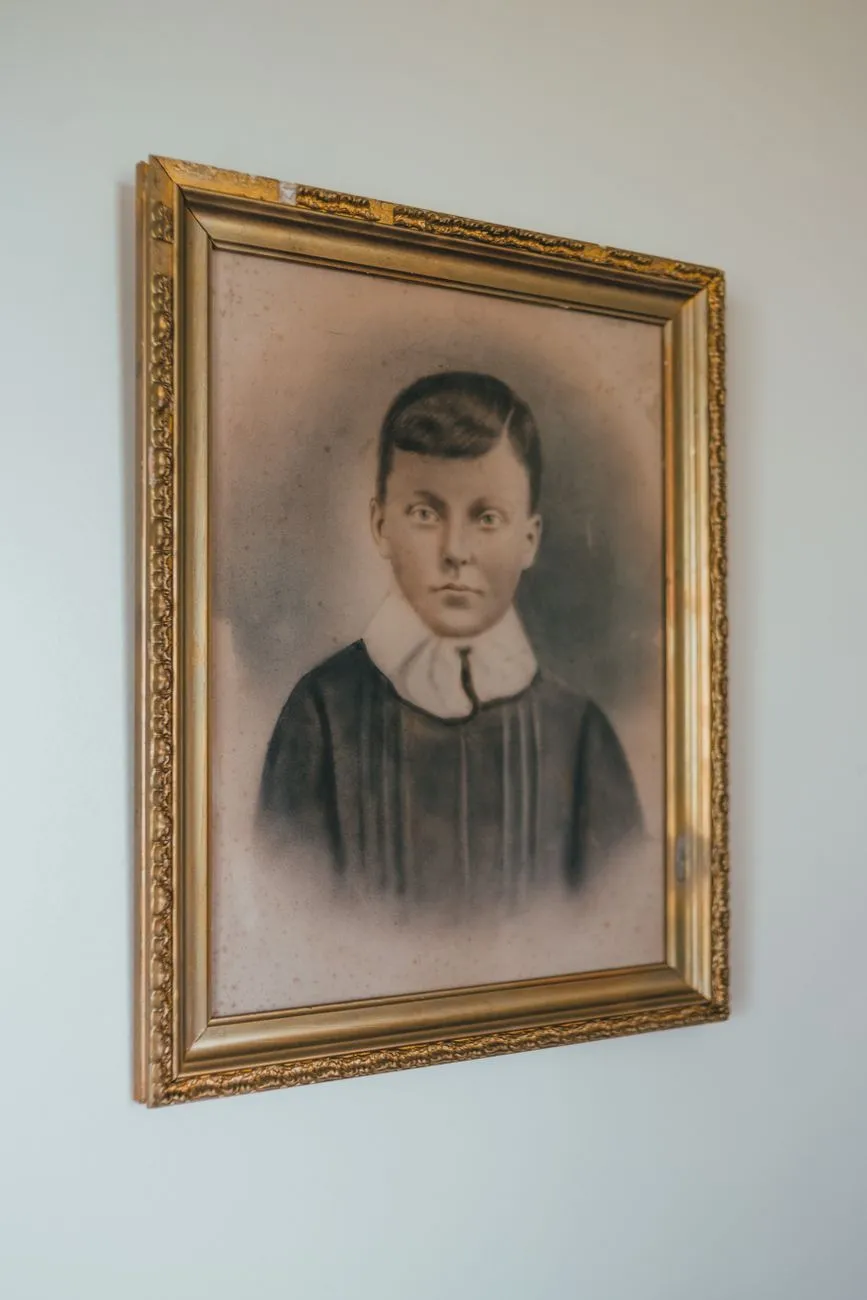
The honest answer is that you should not display the original photograph at all, if it is one you cannot replace. Display a print of the scan instead, store the original flat and in the dark, and treat what is on the wall as something you can reprint whenever you like. That single habit resolves almost every other question in this guide before it comes up.
It sounds like a strange thing for a photo restoration site to say, since the entire point of rescuing an old photograph is usually to look at it. But looking at it and preserving it are not the same goal, and a frame on a wall sits closer to the end of a photograph’s life than the beginning of it.
Why display is the thing that damages photographs
Three things destroy old photographs over time: heat, humidity swings and light. Storage, done properly, removes the first two almost entirely, because a stable interior cupboard does not get hot and does not get damp. Display removes none of them, and it adds the worst one on purpose.
Light bleaches dyes and weakens paper fibres, and it does this continuously, every day the photograph is visible, whether the room is sunny or lit by an ordinary lamp. A photograph that fades on a wall over twenty years was not damaged in a single event. It was damaged in small, identical increments, several hours a day, for two decades, and none of those increments can be undone afterwards. This is also why our guide on why old photos turn orange names light as a cause alongside heat, because the two often do their damage in exactly this slow, unnoticed way.
A photograph you keep in a dark drawer is not being damaged by light at all. A photograph on a wall is being damaged by it constantly. That is the entire tradeoff, and it is why the honest advice is to stop asking the original to do both jobs.
Display a print, not the original
This is the one decision that matters more than any frame, glass or wall choice below.
Once you have a good scan, printing a copy costs very little, and it means the thing hanging on the wall is expendable in a way the original is not. If it fades in fifteen years, you print another one from the same file. If a cousin wants a copy for their own hallway, you print one of those too. None of that is possible once the original itself is the thing on the wall.
Work out what size you can comfortably print from your file with the pixels to print size calculator, and if the number comes back smaller than you hoped, the real fix is rescanning the original at a higher setting rather than stretching a small file. Our guide on what DPI to scan old photos at covers the settings that make a later reprint unnecessary.
If a photograph has faded or darkened badly enough that you are reluctant to display it at all, it is worth checking what a careful restoration can actually recover before writing it off. Our page on faded and darkened photos shows what tends to come back and what does not, so you know what you are printing before you order it.
If you must display the original
Sometimes the original is the point, a cased daguerreotype passed down with the frame it has always lived in, or a print whose physical object matters as much as the image. If you are not going to be talked out of it, do these three things.
UV filtering glazing. Ordinary glass blocks very little ultraviolet light. UV filtering glass or acrylic blocks most of it, and it is worth the extra cost on anything irreplaceable. It slows the damage considerably. It does not stop it, and nothing in a frame can, because visible light itself still fades dyes over enough years, just more slowly than the ultraviolet component does.
A spacer so the image never touches the glazing. A mat, or a set of small spacers built into the frame, holds the print a few millimetres off the glass. Without one, humidity can glue a print to the inside of its glazing over time, and separating the two afterwards usually takes part of the image surface with it. Our guide on freeing a photo stuck to glass covers what that looks like once it has already happened, which is reason enough to prevent it with a spacer in the first place.
Somewhere out of direct light. Covered in full below, but it matters more for an original than for any copy.
Even with all three, understand that you are slowing a loss, not preventing one. That is a reasonable choice to make for an object with its own history. It is not the same thing as preservation.
Choosing the wall
The same four hazards that rule out an attic or a garage for storage apply to a wall, just more slowly.
Direct sunlight is the one to rule out first, including a wall that only catches sun for an hour in the late afternoon. An hour a day, every day, for years, is still years of exposure.
Avoid the wall above a fireplace or a radiator. It is one of the most popular spots for a framed photograph in most houses and one of the worst, because it combines heat with a daily temperature swing as the fire or the heating cycles on and off.
Avoid bathrooms and kitchens. Steam and humidity swings are a problem for the frame’s own materials as well as for what is inside it, and damp conditions are where mould starts, which our mould page covers in more detail.
Avoid a damp exterior wall, particularly in an older house and particularly on the side of the building that gets less sun to dry it out.
What is left, in most houses, is an interior wall in a room that gets everyday use and everyday lamp light rather than a flood of window light. A hallway, a stairwell away from a skylight, or an interior wall of a living room all tend to work. If the only wall you actually want is a bright one, treat that as confirmation that what hangs there should be a print you can cheerfully reprint, never the original.
Treat display as temporary, and rotate what is on it
Museums and archives rotate what they put on display, and the reason is not variety, it is that every hour under light is an hour that does not come back. A photograph on permanent display is taking that damage continuously. A photograph that comes down after a year and goes back in storage, while a different print goes up, is taking a fraction of it.
You do not need a formal schedule for a family home. Swapping a few frames when you happen to be reprinting something, or when the picture on the wall stops feeling current, is enough to turn display from a permanent exposure into an occasional one. It also means a wall that has held the same handful of photographs for a decade is quietly overdue for a change, independent of how faded anything currently looks.
This only works, worth repeating, if what is on the wall is a reprintable copy. Rotating the original in and out of light does not reduce the damage done while it is up, it just spreads a fixed amount of harm across more photographs instead of concentrating it on one.
Put the original away properly
Once a copy is framed and hung, the original’s job is to sit somewhere dark, dry, stable and acid-free, not to also be looked at. Our full guide on how to store old photographs covers the room, the materials and the plastics worth avoiding, and it is the natural next step once the display decision is made.
Label it, lightly and without pressing on the image, so whoever finds the box later knows what it is and that a framed copy exists elsewhere. Our guide on labelling old photos without damaging them covers how to do that without it becoming its own form of damage.
The photograph that stays in a dark drawer for fifty years and the photograph that hangs on a lit wall for fifty years are not ageing at the same rate, even though nothing dramatic ever happens to either of them. Display the copy, keep the original out of the light, and reprint whenever the one on the wall needs replacing. That is the whole answer, and it costs far less than the alternative of losing the original to the slow, ordinary damage of being looked at.
Common questions
- Is it bad to display an old photograph on the wall?
- It is bad to display the original. Light, including the light in an ordinary room, fades and discolours a photograph gradually and permanently, and that damage never reverses. The fix is not to stop displaying photographs, it is to display a copy and keep the original stored away from light.
- Can I display the real photo if I use UV glass?
- UV filtering glazing slows fading, it does not stop it. It is a reasonable compromise for a copy you are not worried about, but for anything irreplaceable the only real protection is keeping the original out of light altogether and hanging a print instead.
- Where in a house is safest to hang old photographs?
- An interior wall in a room you actually use, lit by lamps rather than direct window light, away from a fireplace, radiator, bathroom or kitchen. Avoid any wall that catches sun for even part of the day, since that exposure adds up over years.
- How often should I rotate photos that are on display?
- There is no fixed schedule, but treating display as temporary rather than permanent is the habit that matters. Swapping a few frames once or twice a year, or whenever you happen to reprint something, keeps any single photograph from taking light damage continuously for decades.