How to store negatives and slides
Negatives and slides are not backups for your prints, they are the originals. Here is what sleeves and boxes are actually safe, the vinegar smell that means a roll is failing, and when cold storage genuinely helps.
Most advice about old photographs is really advice about prints. Negatives and slides get a different, shorter conversation, usually “scan them and you’re done.” That gets the priority backwards. The negative is not a backup copy of the print. It is the original the print was made from, and once it is gone, no amount of restoration software brings back detail that was never in the print to begin with.
The print is the copy
A print is one interpretation of a negative, made on whatever paper, chemistry and exposure choices a lab had that day. The negative itself holds more tonal range and more detail than most prints ever showed, which is why a careful new scan of an old negative can genuinely outperform the print sitting in the album next to it. Our guide on scanning 35mm slides and negatives at home covers how to get that detail out, and our 35mm scan resolution calculator shows what resolution actually captures what the film holds, rather than wasting time scanning higher than the source supports.
That reversal matters for storage priority too. If you only have room, time or budget to store one thing properly, store the negative, not the print. A damaged print can often be rescanned from its negative. A damaged negative cannot be rescanned from anything.
Sleeves, pages and boxes that are actually safe
The same three plastics that are safe for prints, covered in our guide on how to store old photographs, apply to film. Look for polyester (sold as Mylar or Melinex), polypropylene or polyethylene named on the pack. Avoid PVC, sometimes labelled vinyl, which stays soft because of plasticisers that slowly migrate out and stick to whatever they touch.
Negatives and slides need enclosures cut for their actual shape, not generic print sleeves.
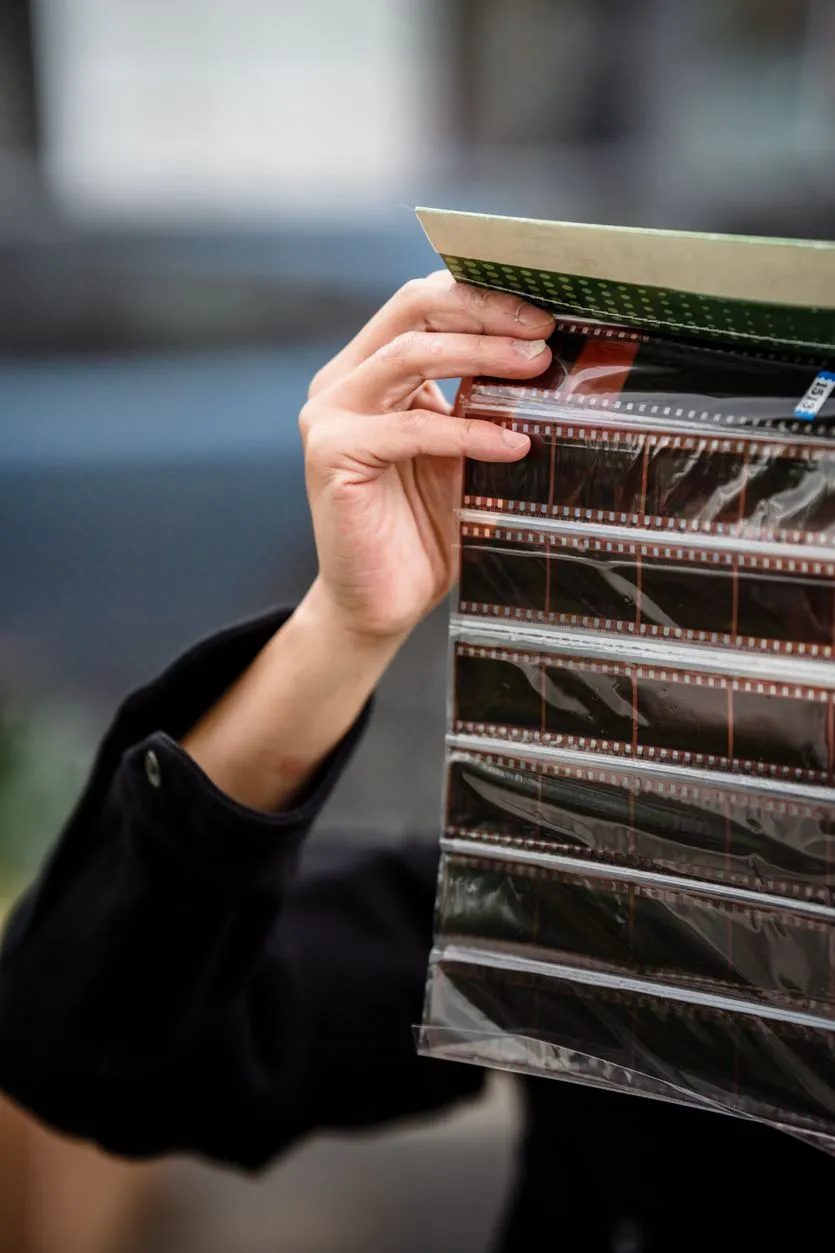
For negative strips, buy archival negative pages, clear sheets with individual channels sized for strips of four to six frames, sold in formats for 35mm, 120 and sheet film. Each strip sits in its own channel rather than touching its neighbours, which matters because film edges are where handling damage starts.
For mounted slides, use archival slide pages with individual pockets, or acid-free boxes with internal dividers that hold each mount upright and separate. Loose slides tipped into a drawer scratch each other every time the drawer opens.
For unmounted slide or negative rolls, acid-free, lignin-free paper sleeves or small archival boxes work, and breathe slightly better than plastic in a damp room, the same trade-off that applies to prints.
Whatever you choose, store strips and mounts upright or flat and fully supported, never loose in a drawer or bundled with an elastic band. Rubber perishes, sticks to film, and leaves a mark that does not come off.
The vinegar smell that means a roll needs isolating today
Older film, especially from the 1950s through the 1980s, often has an acetate base rather than the polyester base used today. Acetate degrades through a chemical reaction that releases acetic acid as it breaks down, the same acid responsible for the smell of vinegar. Conservators call this vinegar syndrome, and the smell is the clearest early warning sign you will get.
A few things are worth knowing about it, because they change what you do next.
It is self-accelerating. Once the reaction starts, it speeds itself up, and it also speeds up in film stored nearby, because the acetic acid released by one degrading roll encourages the same reaction in its neighbours. This is the one case in film storage where keeping everything together is actively the wrong move.
It cannot be reversed. Nothing restores film that has advanced vinegar syndrome. Severely affected rolls shrink, warp, and the image layer can separate from the base entirely. The only genuine intervention is slowing the reaction in film that has not gone that far yet.
Heat and humidity drive it. The same conditions that damage prints, covered in our guide on how to store old photographs, accelerate vinegar syndrome specifically. A hot attic or a humid garage can take film from fine to badly affected in a handful of years.
If you notice the smell, isolate that roll from the rest of your collection immediately, in its own sealed container, away from everything else, and move it somewhere cooler as soon as you reasonably can. If the film also shows a fuzzy or powdery surface rather than a dry chemical smell, that is a different problem, mould, not vinegar syndrome. Mould needs its own isolation and handling, covered in our page on mould spots on old photos, and the two should not be confused, since the response to each is different.
Scan anything with early vinegar syndrome as a priority. A scan taken now, while the film is still readable, is a copy you will not get a second chance to make.
Cold storage, and the condensation rule that makes it useful
Cold slows every chemical reaction in film, including ordinary ageing and vinegar syndrome both. For a valuable collection, or for film already showing early signs of degrading, cold storage is a genuine, well-established conservation technique, not an exaggeration.
A domestic fridge or freezer works for a family collection, as long as you handle the transition correctly, because this is where the technique usually goes wrong.
Seal film in a bag or airtight container before it goes in. A sealed bag with some of the air pressed out keeps humidity away from the film itself, rather than keeping the film exposed to whatever moisture is in the freezer.
Let it warm up slowly, still sealed, before you open the container. This is the rule that matters most and the one people skip. Cold film brought straight into a warm room causes moisture in the air to condense directly onto it, exactly the humidity that damages film in the first place. Leave a sealed bag at room temperature for a few hours, long enough for the contents to reach room temperature while still sealed, before opening it. The condensation then forms harmlessly on the outside of the bag instead of on the film.
Cold storage is for valuable or already-degrading film, not a requirement for everything. A stable, cool interior cupboard, the same advice as for prints, is entirely adequate for a healthy family collection. Reserve the freezer for film you have reason to worry about, or for a collection genuinely worth the extra care.
A simple system for a mixed box
Most family collections arrive as a jumble: some mounted slides, some strips still in their processing envelopes, maybe a few rolls that were never developed at all. A workable system does not need to be elaborate.
- Sort by format first, slides, strips and anything unidentified, since each needs a different enclosure.
- Smell-check for vinegar syndrome as you go, and set anything affected aside in its own container rather than back in the main box.
- Rehouse into archival sleeves or pages sized for what you actually have, and label the outside of each page or box with the rough date and subject, since film is much harder to skim through than a print.
- Store the finished boxes in an interior cupboard, cool, dry and dark, the same conditions that protect prints.
- Scan as you go, starting with anything that smelled of vinegar or looked physically damaged, so the irreplaceable frames are digitised first.
None of this needs to happen in one weekend. Getting film out of loose bundles and elastic bands and into any archival sleeve is already most of the benefit, before you get particular about which plastic or whether a box needs to go in the freezer.
A print can be reprinted from its negative. A negative, once it has gone past a certain point, cannot be remade from anything. Store the original like it is the one copy you actually have, because it is.
Common questions
- Should I throw negatives away once I have scanned and printed from them?
- No. A scan is a copy, however good. The negative is the original it was made from, and it holds detail and dynamic range no consumer scan fully captures. Keep the negative in proper storage even after scanning, so a better scan is possible later as equipment improves.
- What does the vinegar smell from old negatives actually mean?
- It means the acetate film base is breaking down in a reaction that produces acetic acid, the same acid that gives vinegar its smell. This is called vinegar syndrome. It is self-accelerating, warmth and other degrading film nearby both speed it up, and it cannot be reversed. The only real response is to slow it by isolating and cooling the affected roll.
- Can I store negatives and slides in the freezer?
- Yes, and for film already showing vinegar syndrome it is close to the only effective slowdown available. The part people get wrong is taking film straight from a freezer into a humid room. Seal it in a bag while still cold and let it reach room temperature slowly before opening, so moisture condenses on the bag rather than on the film.
- Are the plastic sleeves sold for photo prints safe for negatives too?
- Only if they name the same safe plastics, polyester, polypropylene or polyethylene, and are specifically cut for negative strips or slide mounts. A sleeve designed for a 6 by 4 inch print will not hold a negative strip flat or protect its edges, so buy enclosures made for the film format you actually have.