A photo emergency plan: what to grab and what to do first
Most family photo collections are never touched by a tragedy, but the ones that are rarely give any warning. Here is a plan you can build this weekend: one grab box, one copy that lives somewhere else entirely, and what to actually do in the first hour after water or smoke.
Most family photo collections are never touched by a fire or a flood. That is not a reason to skip this plan, it is the reason nobody has one. Disasters that are rare do not get planned for in the moment, because there is no moment, there is a few minutes of smoke alarm or rising water and then it is over one way or the other.
This is a plan you build on an ordinary afternoon, so that on the day it matters you are not making decisions, you are just following them.
Why a plan beats a scramble
Picture the actual situation. An alarm is going, or water is already over the skirting boards, and you have a small number of minutes and both hands. Nobody in that moment can remember which drawer the wedding album ended up in after the last reorganisation, let alone locate the one shoebox that matters out of a dozen that look the same.
A plan made in advance answers three questions before you need them: what gets carried out physically, what already exists somewhere else entirely, and what you do in the first hour afterwards if the originals do not come through clean. Decide all three now, while you are calm and the photographs are fine, and the emergency itself becomes a much smaller event than it would otherwise be.
The one grab box
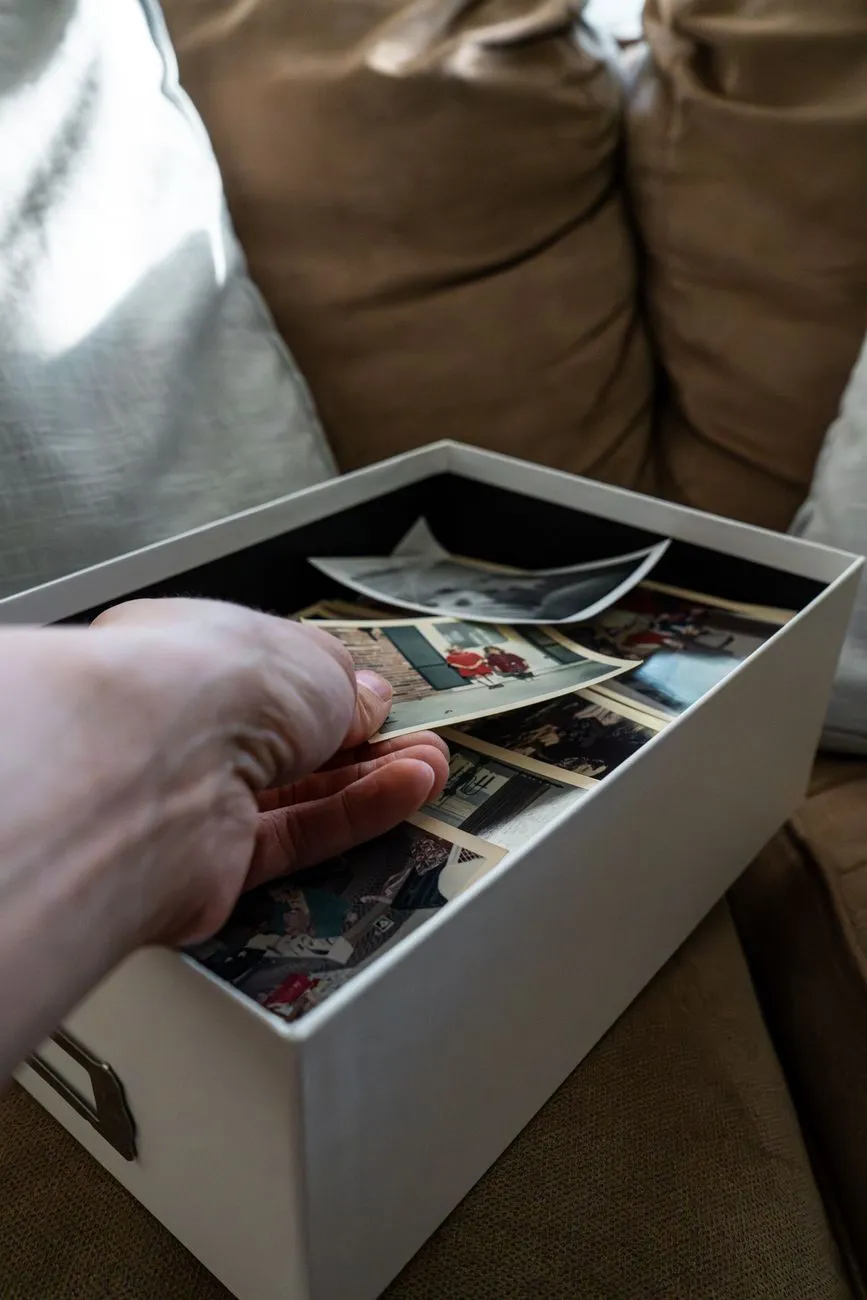
Pick a single, clearly labelled box or folder and put your genuinely irreplaceable originals in it. Not everything, that defeats the purpose. The photographs where no other copy exists anywhere, the ones a relative overseas does not also have, the ones that are the only record of someone. For most families this is a surprisingly small pile once you actually sort for it, often one shoebox rather than the whole collection.
Keep that box somewhere you would actually grab it from on the way out, near the door you use most, not in the attic or the back of a wardrobe where the rest of the archive lives. Our guide on how to store old photographs covers where the bulk of a collection should live day to day, and that is not the same shelf as the grab box. The grab box trades a small amount of long term storage quality for being reachable in under a minute, and that trade is the right one for a small, carefully chosen pile.
Tell at least one other person in the house where it lives. A plan only one person knows about is a plan that fails if that person is not home.
The copy that actually survives the disaster
A fireproof box is worth having, and it is also worth being honest about what it actually promises. Most consumer fireproof boxes are rated for a set temperature over a set number of minutes, which covers a typical house fire reasonably well and a prolonged one badly, and a box rated for fire does nothing for a flood, because the water that destroys a house does not care what the box was built to resist.
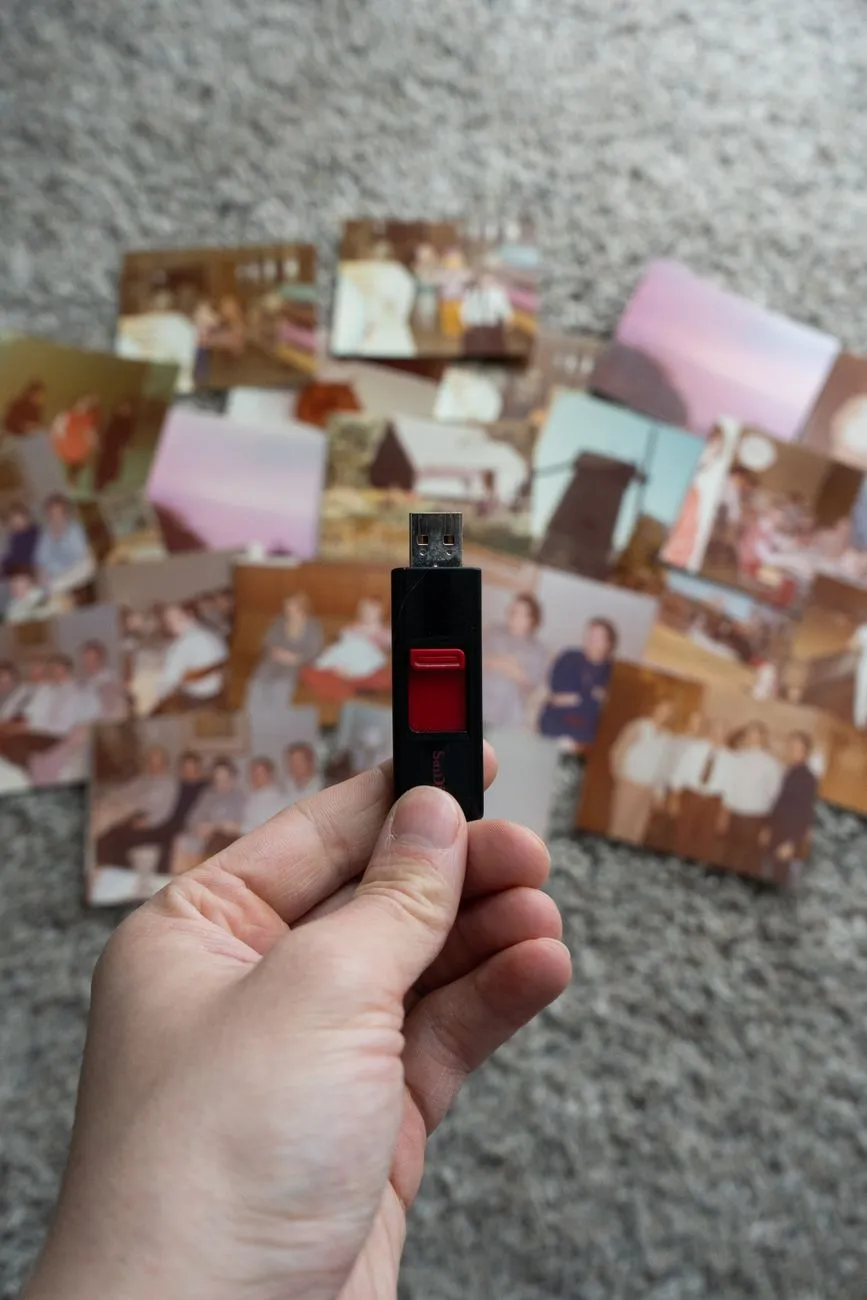
The layer that genuinely survives either event is a digital copy stored somewhere other than your house. If you have already scanned your collection, the job here is checking that a copy exists off site, not creating one from scratch. Our guide on backing up scanned family photos covers the three copies, two kinds of storage, one somewhere else rule in full, and it applies here without changes.
If you have not scanned the photographs in your grab box yet, that is the first task, not an optional extra. Scan the pile, at a setting that will still be worth having in twenty years. Our scan resolution calculator gives you the right DPI for the print size in front of you, and for a small, carefully chosen pile this is an afternoon, not a project. Upload the results somewhere off site the same day. That single digital copy is the one version of this plan that a fire or a flood in your own house cannot touch, because it was never in your house to begin with.
Write it down, somewhere someone else will find it
A one page note, kept with the grab box and shared with at least one person outside the house, should say where the box is, where the digital copy lives and how to get into it, and which photographs in the wider collection matter enough to prioritise if there is ever time for a second trip. None of this needs to be elaborate. It needs to exist and be findable by someone who is not you, because the whole premise of an emergency plan is that you might not be the one executing it.
The first hour after water
If photographs do get wet, speed matters more than technique. Separate them from each other immediately if you can do it without tearing anything, because photographs left stacked while wet is how prints fuse permanently to one another. Rinse off gross mud or debris with clean water if needed, lay prints face up on a clean towel out of direct sun, and get air moving across them with a fan. Do not use heat, and do not leave them pressed together to dry slowly, since that is exactly the condition mould needs.
This is first aid, not restoration, and it is meant to buy time rather than finish the job. Our page on water and ring stains shows what a photograph can look like after this kind of damage and what a recovery genuinely restores against what stays lost, and it is worth reading once before an emergency rather than during one. If prints have already started to stick together by the time you reach them, separating photographs that have stuck together covers the soak method conservators use and the point at which you should stop and simply scan what is still visible.
Damp conditions after a flood also invite mould within days, not weeks, particularly in a closed box that never fully dried out. If you see fuzzy spots or a musty smell on anything that survived, our page on mould spots on old photos covers safe handling, because mould on an old print is a health matter as well as a photograph matter.
The first hour after smoke or fire
Photographs that survive a house fire without direct flame contact are usually damaged by heat, soot and the water used to put the fire out, often in that order. Do not wipe soot off a print, since dry soot ground into an emulsion with a cloth does more harm than the soot sitting there a little longer. Photograph or scan what you can before attempting any cleaning, so that even a print that does not survive handling is preserved as a digital copy first.
Heat-curled or softened prints should be handled exactly as little as possible until they can be assessed properly. A print that has been through heat is more fragile than it looks, and forcing it flat is one of the few mistakes that cannot be undone afterwards.
Building the plan this weekend
In order of value, and none of it requires buying anything:
- Choose the pile. Sort for the photographs that have no copy anywhere else. This is usually smaller than people expect.
- Pick the box and the spot. Somewhere you would actually grab it from on the way out.
- Scan that pile if it is not already digital, at a setting worth keeping using the scan resolution calculator.
- Get a copy off site the same day you scan it, following the backup guide.
- Write the one page note and tell someone else in the house, and ideally one person outside it, where everything is.
None of these steps is difficult on its own, and together they take an afternoon. What they buy you is the thing a scramble never can: a decision that is already made before the day you need it.
Common questions
- What should I grab first in a house fire or flood?
- Whatever you decided in advance, not whatever is nearest the door when it happens. That is the entire point of building a grab box ahead of time: a single labelled container with your most irreplaceable originals, so the decision is already made before you are standing in smoke or rising water trying to make it.
- Can water damaged photographs actually be saved?
- Often, yes, especially if you act within the first day or two. Wet photographs left stacked and drying slowly are far more likely to fuse together or grow mould than photographs separated, rinsed gently if needed and air dried quickly. Our water and ring stains page covers what a recovered print can look like and what tends to be lost for good.
- Is a fireproof box enough to protect photographs?
- It helps, but treat it as one layer, not the plan. Most consumer fireproof boxes are rated to protect paper for a set time at a set temperature, which is usually enough for a brief house fire but not a prolonged one, and none of them help at all in a flood that floats the box into the same water it was meant to resist. A digital copy stored somewhere else entirely is the layer that actually survives either disaster.
- Do I need to scan every photograph before building an emergency plan?
- No, and waiting until every photograph is scanned is how this plan never gets built. Start with the handful that could never be replaced, the wedding portraits, the only photo of a grandparent, the ones nobody else in the family has a copy of. A partial digital backup of the photographs that matter most beats a perfect plan that is still three years from finished.