How to work out who is in an old family photograph
A practical method for identifying people in old family photos when nobody labelled them, starting with the photograph as an object rather than guessing at faces, and how to record what you are still unsure of.
A box of family photographs almost always contains a handful of pictures where nobody wrote anything on the back. Somebody once knew every face in them. Now you are looking at a group of strangers who happen to be your relatives, and the instinct is to stare at the faces and hope one clicks. That rarely works. A better method starts somewhere else entirely: the photograph as a physical object, not as a picture of people.
Start with the object, not the face
Before you try to recognise anyone, read the photograph itself. Three things narrow the decade a print was made, often to within a few years, without anyone needing to identify a single person in it.
The format. A small, thick card with rounded corners is likely a cabinet card or carte de visite from the studio-portrait era. A glossy print with a scalloped white border points to a mid-century snapshot. A colour print with a date stamped in the corner tells you almost exactly when it was developed, even if the event it shows happened earlier.
The mount and the studio imprint. Studio portraits from before about 1920 were nearly always printed on card stock, and the photographer’s name and town were often printed on the front or back. Studios changed address, changed their name, or closed, all on documented timelines, so a printed imprint can sometimes date a photograph to a specific range of years even when nothing else about it is known.
The paper and processing. Borderless prints, particular paper textures and processing marks all shifted over the decades in ways that a scan makes easy to inspect closely. Our scan resolution calculator will tell you the right setting if you want to capture the back of the mount as well as the front, which is worth doing before anything else, because a mount is often more fragile than the print it holds.
None of this tells you who anyone is yet. What it does is rule out decades, and ruling out decades is most of the work.
Elimination beats recognition
Once you have a rough date, the fastest path to a name is usually elimination rather than recognition. Staring at a face and hoping it resolves into a specific relative is slow and unreliable, especially in a group of people you never met. Working out who it cannot be is much faster.
Age gaps tell you generations. If a photograph is from around 1925 and shows a child of about eight, that person was likely born around 1917. Cross that against a family tree, even a rough one, and entire branches drop out immediately because they were not born yet or were already adults with children of their own in the frame.
Group composition tells you the occasion. A stiff, formal arrangement with everyone in their best clothes suggests a specific event, a wedding, a confirmation, an anniversary, rather than an ordinary day. Knowing the likely occasion narrows who would have travelled to be there and who would not.
Who is missing is as informative as who is present. A family photograph missing an adult child who was known to live interstate, or missing a spouse who had not yet married in, can place the picture in a specific year almost as precisely as a studio imprint can.
Repetition across photographs helps. If the same distinctive brooch, walking stick or child’s coat shows up in a labelled photograph and an unlabelled one, that is a genuine link, not a coincidence worth ignoring. Lay photographs from the same period out together rather than examining them one at a time.
This is slower than a glance and faster than guessing, and it produces answers you can actually defend to another relative who disagrees with you.
Reading a group photograph specifically
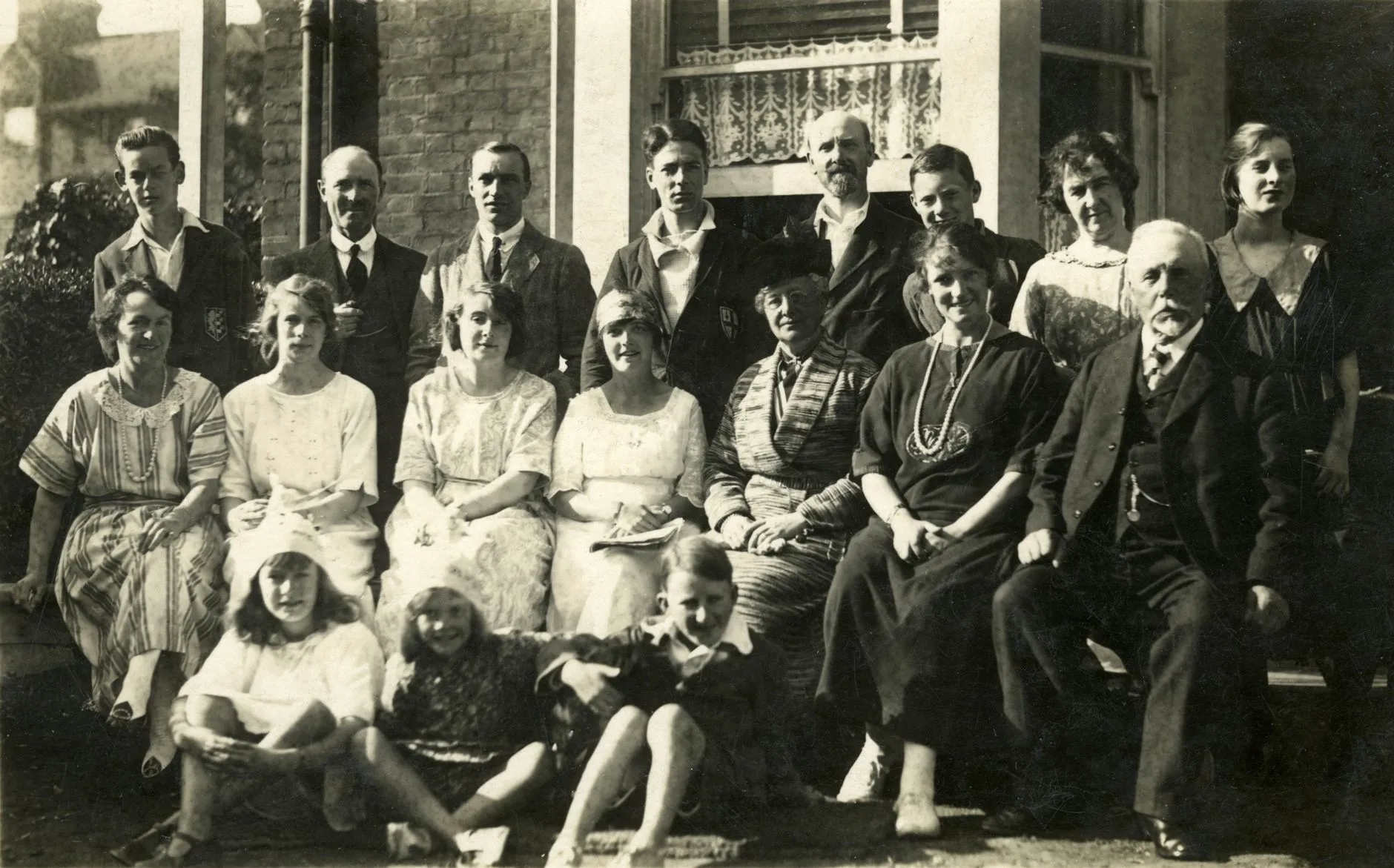
Large group photographs, the kind with three rows on a porch or studio risers, reward a different approach than single portraits. Work outward from whoever you are most confident about, rather than starting at one corner and working across.
Identify the one or two people you are certain of first, usually because a labelled copy of the same photograph or the same person exists elsewhere. Their position in the group, seated at the centre, standing at the back, holding a child, often reflects family hierarchy or relationship at the time, which is a genuine clue to who is standing near them. Grandparents were seated. Married couples tended to stand together. A young child on a lap usually belonged to the adult holding them, though not always.
Work in from there rather than guessing at strangers first. Each confirmed identity narrows the possibilities for the people around them.
Getting a second opinion
Older relatives are still the best resource, and showing them the actual photograph, or a clear scan of it, works far better than describing it over the phone. Faces are recognised, not remembered in the abstract. If nobody in the family can place a photograph, a local historical society or genealogy group covering the town named on the studio imprint can sometimes date, and occasionally identify, a photograph purely from the printed evidence, even when every face in it is a mystery to everyone still alive.
Whatever comes back from a relative or a stranger, treat it the same way you treat your own deductions. Confidence in someone’s voice is not the same as evidence.
Record the uncertainty, not just the answer
The habit that matters most here is not a research technique at all. It is what you do with what you learn, because the next generation inherits your notes, not your reasoning.
Write down what you are sure of, what you are guessing, and how confident the guess is. “Probably my grandmother’s sister, based on the brooch, not certain” is a useful sentence. A name written on the back with no hedge, based on a hunch, is not, because nobody who finds it later has any way to know it was a hunch. A confident wrong label outlives everyone who could have corrected it, and it gets copied into every family tree that touches the photograph afterwards.
If the collection is scanned, the caption belongs with the file rather than only on the physical print. Our guide on backing up scanned family photos covers where that information can actually travel with the image rather than getting separated from it the first time someone copies the file. The original print, meanwhile, should go back into proper storage once you are done handling it. Our guide to storing old photographs covers what protects a print for decades rather than years.
One practical note while you are examining these photographs closely: a faded or darkened print is often harder to read than it needs to be, and the detail that would help you identify a face or a brooch may still be there under the fading. Our page on faded and darkened photos shows what a careful digital recovery can bring back before you give up on a face as unreadable.
When you genuinely cannot tell
Sometimes elimination runs out and nobody can help. That is a legitimate outcome, not a failure of method. A photograph correctly labelled “unidentified, probably 1920s, taken by a studio in Bendigo” is more valuable to whoever inherits it than one with a guessed name attached as though it were certain. The goal is not to resolve every photograph. It is to leave behind an honest account of what is actually known, so the next person working on the same box starts from where you left off rather than from nothing, and does not have to first undo a wrong answer before they can begin.
Common questions
- How do I identify people in an old photo with no names on it?
- Start with the photograph itself rather than the faces. The format, the mount, the photographer's imprint and the clothing narrow the decade first. Once you have a decade, compare the group against what you know of the family at that time, ages, who was alive, who was married yet, and let elimination do most of the work rather than recognition.
- What is the most reliable evidence for dating an old family photo?
- The physical object usually beats the image. A photographer's printed name and address, the card stock or paper the print is mounted on, and the style of the mount itself all narrow a date range more reliably than trying to age a face by eye, because studios and papers changed on a known, researchable timeline.
- Should I write down a guess if I am not certain who someone is?
- Yes, but label it as a guess. A caption that says "probably Grandma's sister, unconfirmed" is far more useful to whoever inherits the photo than a blank back, and far less damaging than a confident wrong name written as fact. Uncertainty recorded honestly can still be corrected. A wrong certainty gets copied forward.
- Who else can help identify people in a family photo I cannot place?
- Older relatives first, shown the actual print or a good scan rather than a description. Beyond that, local historical societies and genealogy groups for the town the studio operated in can sometimes date the photographer's imprint precisely, even when nobody alive recognises the faces.