Can a damaged face be repaired?
How to restore a damaged face in an old photo
A damaged face repairs well when the damage is narrow or tonal, and badly when picture is genuinely missing. Knowing which one you have is the whole job.
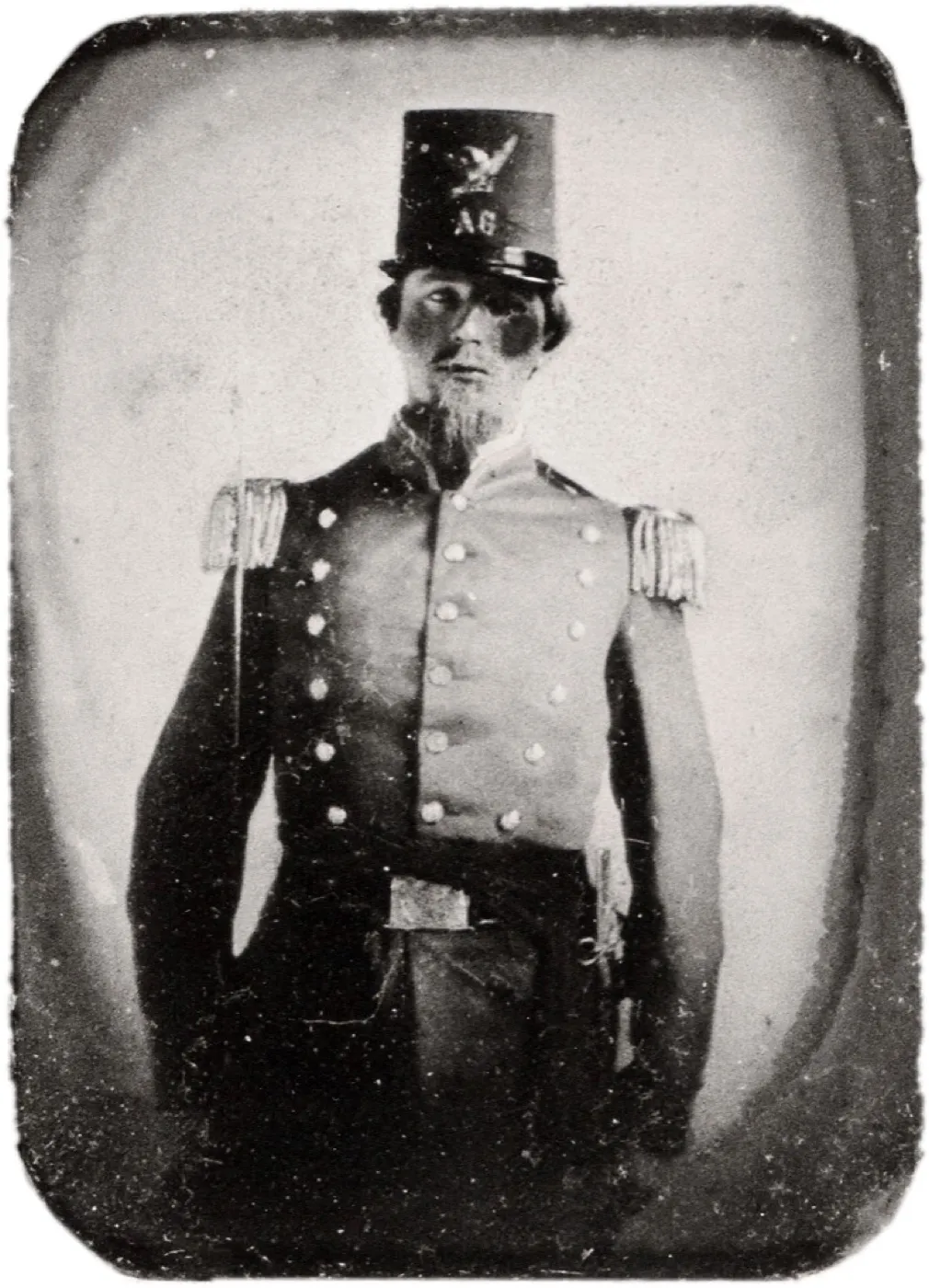 Before
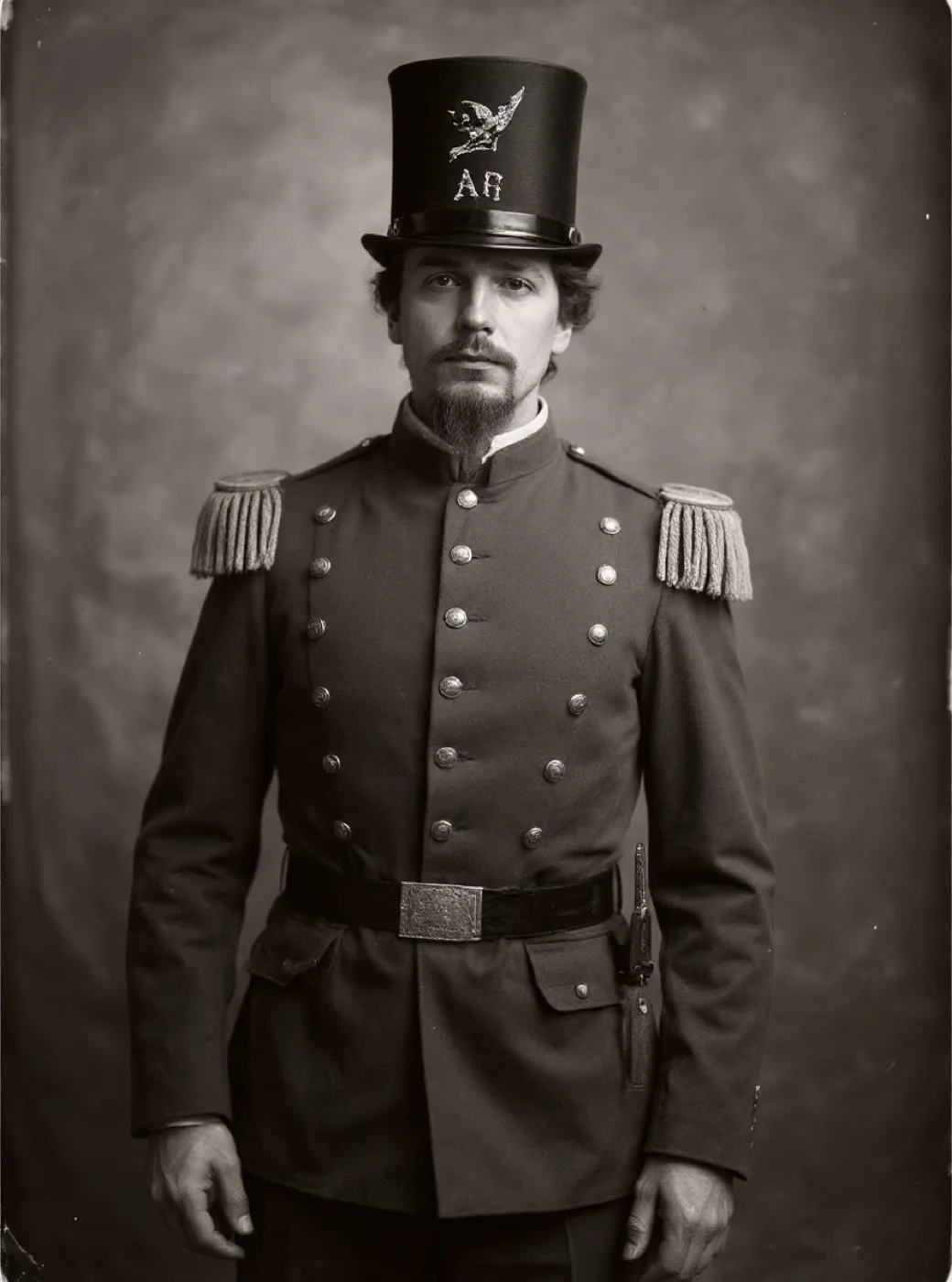 After
AfterA daguerreotype portrait with tarnish spots across the figure
Tarnish over a face is the good case and a worn face is the bad one. This plate carries both, which is why it is the one staged here.
The tarnish came off the plate and the man is still the man: same shako with the same plate on it, same epaulettes, same row of buttons, same stance, same face. Set against the scratched portrait higher up this wall, which came back as somebody else, the difference is how much face survived going in. The detail inside this face is reconstructed rather than recovered, because a plate this worn does not hold it. Open the second frame at full size and judge it before you trust it with a relative.
- Source
- Dandridge McRae in prewar militia uniform, about 1860
- Holder and licence
- Prairie Grove Battlefield State Park, via Wikimedia Commons, public domain, copyright expired
- Control used
- Restore
- Model it called
- flux-kontext-apps/restore-image on Replicate
- Elapsed
- 7.0 seconds
- Output size
- 880 x 1184 px
- Captured
- 17 Sep 2026

What this damage is
Every other part of a photograph has forgiving neighbours. A gap in a coat can be filled from the fabric around it, and a missing patch of sky is sky. A face has none of that slack. Skin next to an eye does not tell you what the eye looked like, the information density is enormous, and it is specific to one person.
A restoration model has learned what faces look like across an immense number of photographs, which is exactly why it can produce a convincing face and exactly why it cannot produce yours. Given a missing area it composes the most likely face, and most likely means average. A slightly crooked nose, unusual eye spacing, a particular set of the mouth: those are precisely what gets smoothed toward the middle.
Can it be fixed?
Scratches, stains, fading and grime across a face come back convincingly, because surviving detail surrounds the damage and constrains the repair. A face largely worn away cannot be recovered, and what appears in its place is a plausible face rather than the person's. Most of the winnable ground is before the repair: scan higher than you would for the rest of the photograph, do not touch the print, and look for another copy of the same face, because a second copy turns an invention back into a repair.
What each kind of face damage will actually do
- A stain or ring over a face is the best case on this list. The face underneath is usually intact and the mark is a tonal layer over it.
- Fading, darkening and grime are also excellent. Contrast collapses long before detail does, so faces that look almost gone often return in full.
- A narrow scratch across a face is good, with a caveat. The line goes and the face reads naturally, because the gap is thin and bounded by real skin on both sides. It is reconstruction, but tightly constrained reconstruction.
- A tear through a face is harder and depends entirely on width. A clean split where the pieces still meet can be nearly invisible afterwards. A tear where paper is gone means a missing strip of face.
- Abrasion or emulsion loss across a face is the one we will not pretend about. Where the image layer has worn away, nothing survives to rebuild from.
- A face that was never sharp has nothing to recover, because nothing was recorded. Sharpening produces crispness, not likeness.
How to judge the result
Do this before you send the file to anyone, because once it is in the family group chat it is the photograph.
- Compare at full size, side by side with the capture. Not on a phone, not at thumbnail scale. Nearly all invented detail is invisible small and obvious large.
- Check four landmarks specifically: the spacing and shape of the eyes, the hairline, the shape of the mouth, and the line of the jaw and nose. These carry identity. Skin texture and sharpness do not.
- Ask whether it is the same person, not whether it is a better photograph. These are different questions, and the second one flatters almost every result.
- Distrust improvement that arrived from nowhere. Crisp eyelashes, even teeth and clean jewellery on a print that never showed them are the signature of composition rather than recovery.
- Show it to someone who knew them, without prompting. Say nothing about what you did. Hesitation is a result, and it costs nothing.
The line between repair and invention
Removing damage from a face that survives underneath is a repair, and it is one of the most worthwhile things this technology does. Constructing a face where the photograph no longer holds one is an invention, however good it looks, and calling it a restoration is not honest.
When you are on the invention side of that line, restore conservatively: fix the whole photograph, correct the tone, clean the background and the clothing, and leave the face softer rather than pushing it to a crisp reconstruction. A slightly damaged face that is still the person beats a perfect face that is not.
Keep the master beside the result, because models improve every year. And say what you did in one sentence when you share it, so the photograph stays a record and nobody inherits a reconstruction as fact.
Where the repair stops
Where the image layer has worn away there is nothing to rebuild from, and the face that appears is an invention. That is true of our app as well as anybody else's: it runs the same class of model, so it sits on the same side of the same line.
Before any repair, get a proper scan: the DPI advisor gives the right setting in two questions, and the scanning guide covers the craft.
This page absorbed the damaged face guide, merged here on 16 Sep 2026. Nothing was deleted: the old address now leads here.
One damaged portrait, judged on four landmarks only: eye spacing, hairline, mouth and jaw line, run through three tools on the same day.
Photo Restore
Our own app, the Restore control
- Elapsed
- Awaiting the run
- Verdict
- Not written yet
Pending a run: every restoration is billed to a hosted model, so it needs sign-off.
MyHeritage Photo Enhancer
Free tier, with In Color
- Elapsed
- Awaiting the run
- Verdict
- Not written yet
Pending the chairman: the free tier will not release a result without an account.
Remini
Free tier, the enhance preset
- Elapsed
- Awaiting the run
- Verdict
- Not written yet
Pending the chairman: the free tier is an app install behind a sign-in.
When these three frames exist, this bench will say plainly what each tool beats us at. A comparison that only ever finds us in front is an advert, and we have said so on the about page since July.
Five things to do to the original, in this order
- Scan the print higher than you would for anything else. The face is a small part of the file.
- Do not wipe, polish or tape anything near the damaged area.
- Look for a second copy of the same face before you repair anything.
- Photograph the print rather than scanning it if it is brittle or mounted.
- Keep the untouched capture next to every result you produce.
Common questions
- Can a damaged face in an old photo be repaired?
- Usually, if the damage is narrow or tonal. A scratch across a cheek, a stain over a face, fading and grime all repair well because real detail surrounds the damage and constrains the reconstruction. A face largely worn away, or one that was never in focus, cannot be recovered. What appears there instead is a plausible face rather than that person's face.
- Why do AI restored faces sometimes look like a different person?
- Because the model rebuilds from what faces look like in general, not from photographs of your relative. Where detail is genuinely missing it composes something plausible, and plausible means average. Distinctive features soften toward a generic version, which is why people who knew the person notice immediately that something is wrong without being able to name it.
- How do I check whether a restored face is still the right person?
- Open the original capture and the restoration side by side at full size and compare four things: the spacing and shape of the eyes, the hairline, the shape of the mouth, and the line of the jaw and nose. Then show it to someone who knew them without saying what you did. Those two checks catch nearly everything.
- Is it better to leave a damaged face alone?
- Sometimes, yes. A softly damaged face that still reads as the person can be more truthful than a crisp reconstruction that does not. A good compromise is to repair the damage around the face fully, correct the tone across the whole photograph, and treat the face itself conservatively so it stays recognisably the original.
- Can a professional restore a face better than AI?
- On a face with real loss, usually yes, because a skilled restorer can work from other photographs of the same person, from family knowledge and from period context, and can make a defensible decision about what belonged there. It is still a reconstruction. What you are buying is better judgement about the invention, not the removal of it.
- Should I tell the family the face was reconstructed?
- Yes. It costs one sentence and it protects the photograph's standing as a record. A restored portrait that everyone knows was rebuilt is a keepsake. One that is quietly passed off as recovered becomes the family's idea of what someone looked like, and that is difficult to undo later.
The damage is the before. You hold the after.
Real repairs on real photographs. Your family's copies deserve the same rescue.